
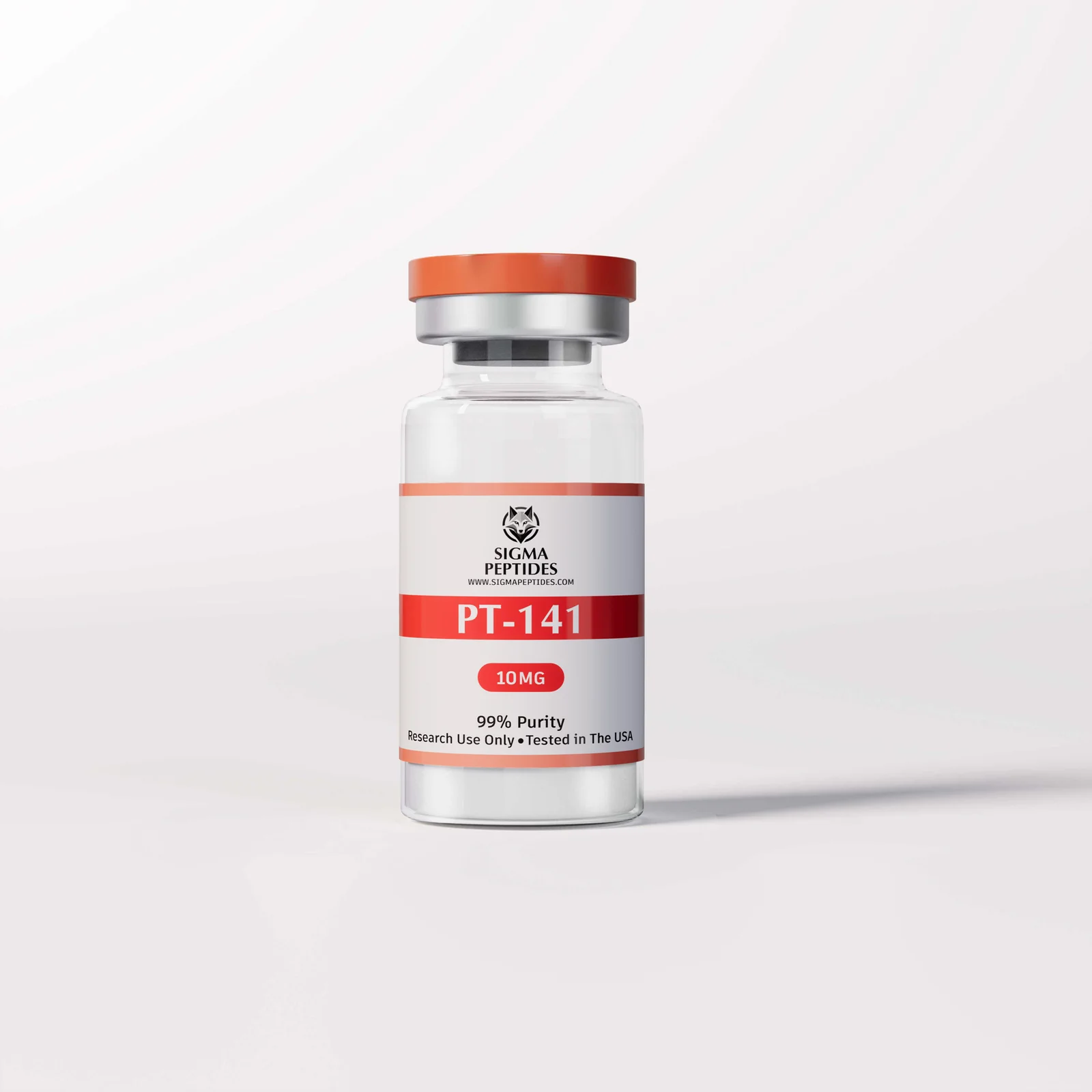
PT-141 10mg
Melanocortin Receptor Research Peptide
$39.99$29.99
Synthetic Alpha-MSH Analog for Central Nervous System Research
PT-141, also known as Bremelanotide, is a synthetic research peptide structurally derived from alpha-melanocyte-stimulating hormone (α-MSH). Unlike other melanocortin analogs that primarily target skin pigmentation, PT-141 is highly valued in laboratory settings for its specific interaction with the MC3R and MC4R receptors in the central nervous system.
This peptide is an essential tool for researchers investigating neurochemical pathways, non-hormonal behavioral responses, and peptide-mediated signaling within the brain.
Core Research Highlights
In preclinical and in vitro models, PT-141 is used to explore:
Central Nervous System (CNS) Signaling: Researchers utilize it to map neuronal pathways influenced by the MC3R and MC4R melanocortin receptors.
Arousal and Response Pathways: It is a key compound in behavioral neuroreceptor studies, examining arousal and physiological response mechanisms under controlled experimental conditions.
Peptide-Receptor Binding: PT-141 serves as a model for studying the dynamics of ligand binding and subsequent intracellular signaling cascades.
Neurochemical Dynamics: Its high binding affinity makes it suitable for modeling neurochemical responses that do not rely on traditional hormonal pathways.
Technical Specifications
For precise scientific documentation, the following chemical properties define this compound:
Feature | Specification |
Product Name | PT-141 (Bremelanotide) 10mg |
Purity | 99%+ (Batch-tested and third-party verified) |
Sequence | Ac-Nle-cyclo[Asp-His-D-Phe-Arg-Trp-Lys]-OH |
Molecular Formula | $C_{50}H_{68}N_{14}O_{10}$ |
Molecular Weight | 1025.2 g/mol |
CAS Number | 189691-06-3 |
PubChem CID | 9941370 |
Preparation and Handling
PT-141 is provided as a lyophilized (freeze-dried) powder in a sealed sterile vial to ensure maximum potency and chemical stability.
Reconstitution: Requires Bacteriostatic Water prior to laboratory use.
Best Practices: Reconstitute by slowly introducing the diluent down the side of the vial to minimize mechanical stress on the peptide structure.
Required Supplies: Standard research supplies, including sterile syringes, needles, and alcohol prep pads, are necessary for proper handling.
Storage and Safety Guidelines
Strict temperature controls are required to prevent the degradation of the peptide sequence:
Lyophilized (Dry) Storage: Store at 39°F (4°C) for up to 2 years, or -4°F (-20°C) for up to 3 years for long-term stability.
Reconstituted (Liquid) Storage: Once dissolved, the solution must be kept refrigerated and used within a narrow research window to maintain integrity.
Safety Warning: This product is intended for in-vitro laboratory research only. It is not approved for human or animal consumption, nor for use in clinical trials.