
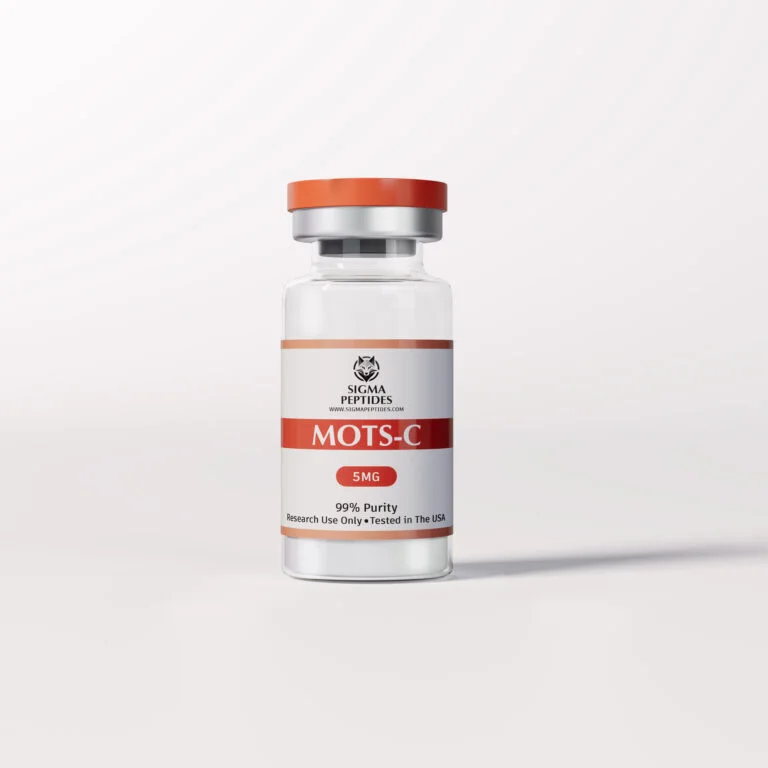
MOTS-c 10mg
Mitochondrial-Derived Research Peptide
$40.00$29.99
Advanced Regulator of Cellular Energy and Metabolic Homeostasis
MOTS-c (Mitochondrial Open Reading Frame of the 12S rRNA type-c) is a unique peptide encoded within the mitochondrial genome rather than the cell nucleus. Discovered in 2015, it has become a focal point in laboratory research for its role as a "mitochondrial signal" that communicates with the nucleus to regulate systemic metabolism and cellular stress responses.
This peptide is primarily associated with the Folate-AICAR-AMPK axis, making it an essential tool for researchers studying metabolic pathway modeling and energy regulation.
Core Research Highlights
In preclinical and laboratory settings, MOTS-c is utilized to investigate several critical biological processes:
AMPK Pathway Activation: MOTS-c is extensively studied for its ability to influence the AMPK signaling cascade, a master regulator of cellular energy balance.
Mitochondrial Signaling: Research indicates that MOTS-c expression levels fluctuate in response to nutrient availability and cellular stress, offering insights into how mitochondria adapt to environmental changes.
Metabolic Homeostasis: Preclinical models utilize MOTS-c to study the modulation of substrate utilization (how the body uses fats and sugars) and adaptive energy mechanisms.
Stress Adaptation: It is investigated for its role in helping cells survive and function under metabolic stress or nutrient deprivation.
Technical Specifications
For precise laboratory application, the following chemical properties define this compound:
Feature | Specification |
Product Name | MOTS-c 10mg |
Purity | 99%+ (Batch-tested and third-party verified) |
Sequence | Met-Arg-Trp-Gln-Glu-Met-Gly-Tyr-Ile-Phe-Tyr-Pro-Arg-Lys-Leu-Arg |
Molecular Formula | $C_{101}H_{152}N_{28}O_{22}S_{2}$ |
Molecular Weight | 2174.64 g/mol |
CAS Number | 1627580-64-6 |
Preparation and Handling
This product is provided in a lyophilized (freeze-dried) powder form to ensure maximum stability.
Reconstitution: Requires Bacteriostatic Water prior to use. The diluent should be introduced slowly into the vial to maintain the structural integrity of the peptide.
Required Supplies: Conducting research with this vial requires additional lab supplies, including sterile syringes, needles, and alcohol prep pads for sanitizing vial stoppers.
Storage Guidelines
To prevent degradation of the peptide sequence, strict temperature controls are required:
Lyophilized (Dry) Powder: Store at 39°F (4°C) for up to 2 years, or at -4°F (-20°C) for up to 3 years for long-term preservation.
Safety Warning: This product is intended for in-vitro laboratory research only. It is not approved for human or animal consumption, nor for use in clinical trials.